First ten minutes, first hour, first week: how the original actually works
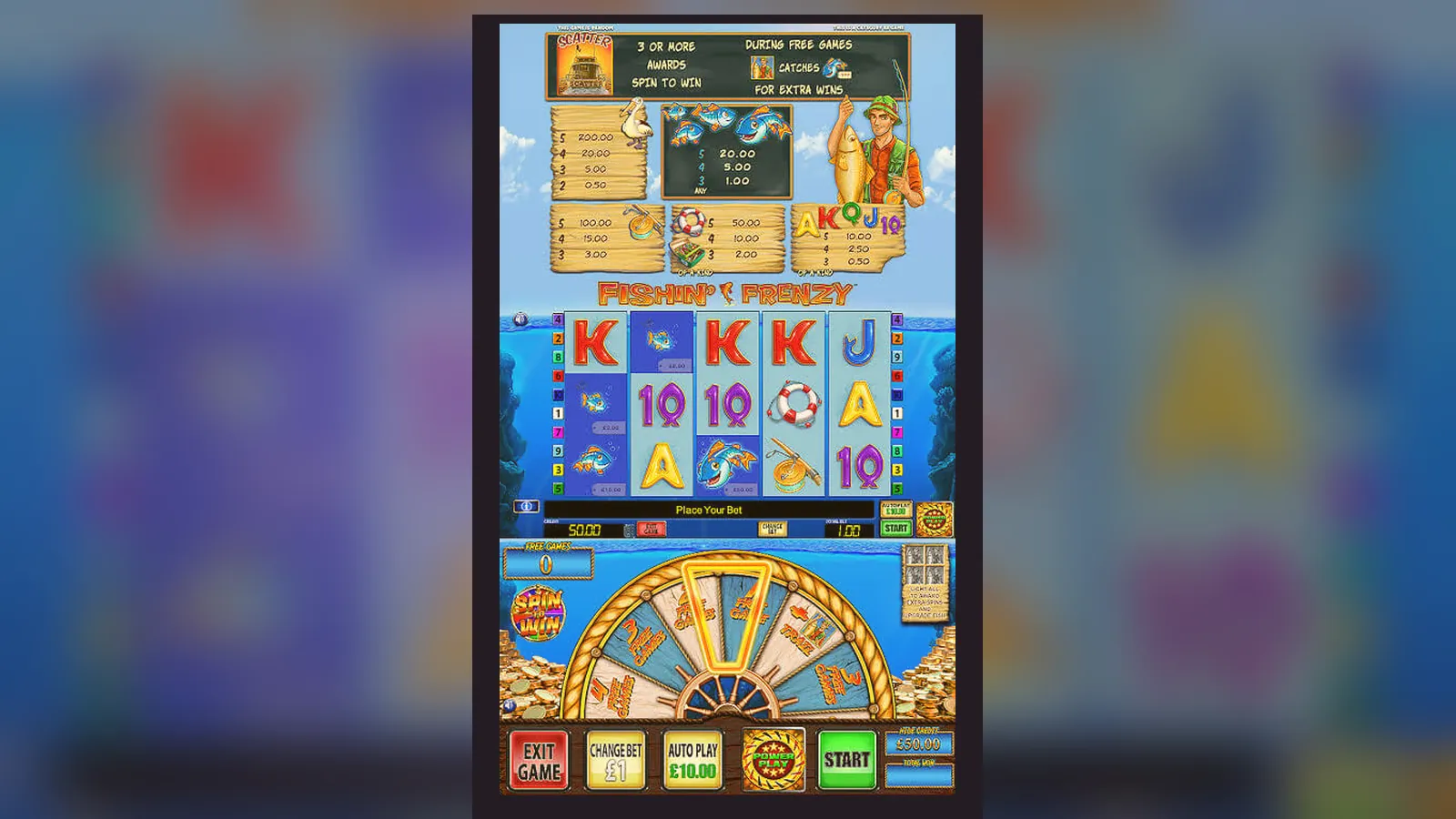
The original Fishin Frenzy came from Blueprint Gaming in 2014, carries third-party RNG certificates, and runs on UKGC-licensed sites under the £5 stake cap — £2 if you're 18–24. A round takes fifteen seconds: you pick a stake, press spin, and either the base game pays or three scatter fishermen trigger ten free spins with a prize multiplier. The maths sheet calls it medium-high volatility at 96.12% RTP, which in practical terms means long dry runs and occasional cluster wins.
This page walks through the chronology: what happens in your first ten minutes, what you notice in the first hour, and what the pattern looks like after a week of sessions. You'll see the real numbers from the technical specification, the mechanics broken down step by step, the clones that circulate and how they differ, and a ten-second check that you're on the genuine Blueprint reel set. Every figure here comes from the pay table and the certified maths model, not marketing copy.
First ten minutes: the certified base game and what you actually control
Blueprint Gaming holds the intellectual property and commissioned the original maths model from an accredited test house — iTech Labs or Gaming Laboratories International, depending on the market. The UKGC register lists Blueprint's remote supplier licence; the casino operating the game holds the remote operating licence, and the footer on a legitimate site will show the licence number you can cross-check in the public register. That chain — supplier certified, operator licensed, and the RNG independently audited — is what «original» means in regulatory terms.
When you open the game, you set a stake between £0.10 and £5.00 per spin. If you're 18–24, the platform enforces a £2 cap automatically; if you're 25 or older, the cap is £5.00 under April 2025 rules. You can't exceed those limits without a system error. The stake buys all ten pay lines at once — you don't toggle lines individually — so a £1.00 spin is £0.10 per line. Press spin, the reels stop in roughly two seconds, and the client checks for winning combinations left to right across those ten lines. Any win animates, credits add to your balance, and the round ends. No decisions mid-spin, no skill element, and no way to influence the outcome once the server generates the result.
In those first ten minutes, you'll see the base-game symbol ladder: low-value playing-card ranks 10 through ace, then fishing tackle — rod, float, box, and a lifebelt — as the picture symbols. The pelican is the top base-game payer at 500 coins for five on a line, which translates to 50× your total stake because ten lines share the bet. The fisherman is the scatter: land three anywhere on reels one, three, and five to trigger the bonus. The lifebuoy is wild and substitutes for everything except the scatter.
First hour: free spins, the prize-fish mechanic, and what medium-high volatility feels like
After twenty or thirty base-game spins, you'll likely trigger the feature at least once — the scatter hit rate is roughly one in forty spins on average, though variance means you could see back-to-back triggers or a hundred-spin drought. Three scatters award ten free spins. During those ten spins, any fish symbol that lands turns into a cash prize between 2× and 50× your stake, and at the end of the round the fisherman collects every prize on screen and adds the total to your balance. The maths model allocates most of the game's return to this feature: base-game wins are smaller and rarer, so the free spins carry the long-term RTP.
Medium-high volatility means the prize distribution is lumpy. You'll see frequent feature triggers that pay 10× to 30× your stake — enough to cover a dozen losing spins but not enough to push you into profit. Every so often, a feature lands eight or nine high-value fish and delivers 100× to 200× your stake. The certified maximum is 5,000× stake, which requires a near-perfect fish distribution across all ten spins and hitting several 50× prizes. At a £5.00 stake, that's a £25,000 cap; at £0.10, it's £500. The probability of max win sits below one in a million spins, so treat it as a theoretical ceiling rather than an expected outcome.
- Base game: land three fisherman scatters on reels 1, 3, and 5 (any row position).
- Trigger: ten free spins start immediately; the bet per spin is locked at the triggering stake.
- Prize reveal: every fish symbol that lands during free spins turns into a cash value (2×, 5×, 10×, 15×, 20×, or 50× stake).
- Collection: after the tenth spin, the fisherman collects all visible fish prizes and adds the sum to your balance.
- Retrigger: land three more scatters during the feature to add another ten spins; the maths sheet allows multiple retriggers in a single bonus.
In your first hour, you'll recognise the rhythm: base-game spins bleed the balance slowly, a feature trigger recovers some of the loss, and occasionally a strong bonus pushes you ahead. The RTP of 96.12% is a long-term average across millions of spins, not a guarantee for a single session. Short-term results swing above and below that figure, and medium-high volatility amplifies the swings. If you hit two weak features in a row — three or four small fish totalling 15× stake — you're still down overall. A single 150× feature can reverse an hour of losses, but it's not predictable.
First week: session patterns, balance trajectory, and the maths you can't bypass
Play daily for a week, and the volatility profile becomes visible in your transaction history. Sessions cluster into three archetypes: slow erosion where features trigger but pay below average, resulting in a 30–50% balance loss; breakeven stretches where a couple of decent bonuses offset base-game losses; and the rare spike session where a 100×-plus feature lands early and you finish ahead. The proportions lean toward erosion because 96.12% RTP means the house edge is 3.88%, and that edge compounds over hundreds of spins.
A week also surfaces the practical realities of playing on a UKGC-licensed site. If your net deposits cross £150 in a calendar month, the operator will begin affordability checks — starting with soft data from credit-reference agencies, escalating to requests for payslips or bank statements if the deposits continue. That threshold is firm across all UKGC licensees since the regulatory tightening in late 2024. GAMSTOP registrations block access for six months to five years if you self-exclude, and that block covers every licensed operator. Deposit limits, session reminders, and reality checks are mandatory platform features, and you'll encounter them if you play regularly.
| Session type | Feature frequency | Typical result | Balance impact | |
|---|---|---|---|---|
| Slow bleed | 1–2 weak features per 100 spins | Features pay 10×–25× stake | −30% to −50% over 200 spins | → |
| Breakeven grind | 2–3 average features per 100 spins | Features pay 25×–60× stake | ±10% over 200 spins | → |
| Spike session | 1 strong feature early | One feature pays 100×–200× stake | +50% to +150% over 100 spins | → |
The certified RNG means every spin is independent. A losing streak doesn't make the next feature «due», and a big win doesn't reset the probabilities. The maths model distributes outcomes according to fixed weightings across millions of spins; your sample of a few thousand spins will deviate from the mean, sometimes by a wide margin. That's variance, and it's baked into the medium-high volatility rating. After a week, some players will be ahead, most will be down, and the aggregate will trend toward the 96.12% RTP.
Clones, reskins, and how to spot the original in ten seconds
Blueprint Gaming licensed the Fishin Frenzy brand for sequels — The Big Catch, Megaways, Jackpot King, and several others — but the 2014 original remains distinct. The base game is a fixed 5×3 grid with ten lines, the free-spins feature awards exactly ten spins with no progressive multiplier, and the max win is 5,000× stake. The sequels add mechanics: Megaways introduces variable reel heights and up to 15,625 ways to win, The Big Catch includes a four-level progressive jackpot, and Prize Lines overlays a cash-ladder feature. Each sequel carries a different maths model and a higher or lower RTP depending on the configuration.
Unlicensed clones circulate under names like «Fishing Frenzy», «Fishin Gold», or «Ocean Catch». These games mimic the theme and symbols but run on unaudited RNG engines, often hosted by offshore operators without UKGC licences. The pay tables look similar at first glance, but the actual return percentage and volatility are unverified, and there's no regulatory recourse if the game behaves unfairly. The UKGC bans marketing of unlicensed sites to British players, and payment processors routinely block transactions to those domains. If the site footer doesn't list a UKGC licence number that cross-checks in the public register, it's not legal for you to play there.
- Open the game and check the loading screen: the original displays «Blueprint Gaming» and the game logo «Fishin Frenzy» without suffixes like Megaways or Jackpot King.
- Tap the menu or information icon and open the pay table: the top symbol is the pelican at 500 coins for five, and the free-spins rule states «ten free games» with no mention of multipliers or progressive features.
- Check the reel grid: 5 reels, 3 rows, and ten pay lines. If the grid changes height or the line count fluctuates, you're on a Megaways variant.
- Scroll the casino footer: a UKGC-licensed operator will display the licence number and a link to the UKGC register. Match the number in the register to confirm the operator's legitimacy.
That check takes less than ten seconds and eliminates both sequels and clones. The original is the most widely distributed Blueprint slot in the UK market, so it appears on dozens of UKGC-licensed sites. Each operator runs the same certified game build, but bonus terms, wagering requirements, and withdrawal processes differ by casino. Those differences sit outside the game itself — they're commercial terms set by the operator, not technical changes to the RNG or pay table.
Where the original runs and what real-money play actually requires
Blueprint Gaming supplies the original Fishin Frenzy to UKGC-licensed operators through aggregator platforms. You'll find it on sites like Buzz Bingo, Paddy Power, Sky Bet, Betfair, and William Hill — those are examples, not an exhaustive list, and availability changes as operators rotate their portfolios. Every listed site holds a remote operating licence; check the footer for the licence number and cross-reference it in the UKGC public register if you want certainty. Unlicensed sites occasionally host pirated or cloned versions, but those aren't legal for British players and lack the regulatory protections that licensed operators provide.
Demo play exists on some UKGC sites, but many operators restrict free-play mode to logged-in, age-verified accounts. That means you'll complete registration and identity checks — uploading a photo ID and proof of address — before you can access the demo. The verification process takes 24 to 48 hours on a first attempt, longer if the documents are unclear or the details don't match credit-reference records. Real-money play requires a deposit from a payment method in your own name; credit cards have been banned for gambling since April 2020, so you'll use a debit card, PayPal, Apple Pay, or open banking via Trustly or similar. Some sites accept paysafecard for deposits, though that's less common now.
Withdrawals go through the same payment method you used to deposit, where possible. E-wallets like PayPal or Skrill process in a few hours to 24 hours; Faster Payments to a UK bank account usually arrive same day to two working days; debit card withdrawals take one to three working days. The first withdrawal is always the slowest because the operator manually reviews your documents and cross-checks your transaction history for anti-money-laundering compliance. Subsequent withdrawals are faster, though affordability checks can pause processing if your deposits exceed £150 net in a calendar month. Gambling winnings are tax-free for you; the operator pays 40% Remote Gaming Duty on gross profits, a rate that increased in April 2026.
Technical certification, RNG audits, and what «provably fair» actually means here
Blueprint Gaming commissions RNG certification from independent test houses — typically iTech Labs, Gaming Laboratories International (GLI), or eCOGRA. The test house validates that the random number generator produces statistically random outcomes over millions of simulated spins, that the observed RTP matches the theoretical model, and that the game meets technical standards for reel-strip design and payout distribution. The certification report is confidential between Blueprint and the test house, but the UKGC requires suppliers to hold valid certificates as a condition of the remote supplier licence.
The phrase «provably fair» originates in cryptocurrency gambling, where the player can verify each result using cryptographic hashes. Fishin Frenzy doesn't use that system; instead, it relies on regulatory oversight. The UKGC audits suppliers and operators, test houses audit the RNG, and the licensed casino logs every spin in a tamper-proof database that the regulator can inspect. You can't verify an individual spin yourself, but the certification chain provides institutional accountability. If the game behaved unfairly, the operator risks losing the licence, and Blueprint risks losing the supplier certification.
- Server-side RNG: the random number generator runs on Blueprint's server, not in your browser, so local manipulation isn't possible.
- Fixed pay table: the symbol values and feature rules are identical across every UKGC-licensed deployment; operators can't alter the maths.
- Audited over millions of spins: the test house runs Monte Carlo simulations to confirm the observed RTP converges on 96.12% over a sample large enough to smooth variance.
- Regulatory supervision: the UKGC conducts compliance audits, and any discrepancy between the certified model and live behaviour triggers an investigation.
That structure doesn't eliminate variance — short-term results will deviate from 96.12%, sometimes dramatically — but it does mean the game isn't rigged in the colloquial sense. The house edge is transparent, the RNG is audited, and the operator can't alter outcomes. Whether you personally finish ahead or behind depends on variance and when you stop playing, not on manipulation. Medium-high volatility guarantees that some sessions will feel punishing; that's the maths working as certified, not evidence of foul play.
What the chronology reveals about design intent and player expectations
The first ten minutes show Blueprint's design restraint: no cascading reels, no progressive multipliers, and no mid-spin decisions. The game is a mechanically simple three-row, ten-line slot with a single bonus round. That simplicity was standard in 2014 and looks dated next to modern feature-stacked slots, but it also makes the game fast and legible. A round completes in fifteen seconds, the rules fit on two pay-table screens, and there's no learning curve beyond «three scatters trigger free spins». Players who want mechanical depth will find the game boring; players who want transparent maths and quick sessions will appreciate the lack of complexity.
The first hour exposes the volatility trade-off. Base-game wins are small and infrequent because the RTP is concentrated in the free-spins feature. That structure creates tension: you're bleeding balance slowly, waiting for the feature, and when it finally triggers, the result swings between disappointing and euphoric depending on fish distribution. The average feature pays around 30× to 40× stake, which recovers some losses but rarely puts you ahead. The occasional 100×-plus feature is what keeps the game interesting, but medium-high volatility means those big hits are separated by long stretches of underwhelming results.
The first week clarifies the gap between mathematical expectation and subjective experience. The game will return 96.12% of total stakes over millions of spins, but your personal sample of a few thousand spins won't converge on that figure. You might finish 20% down, 10% up, or break even, and the result will feel arbitrary because variance dominates over short samples. The UKGC's stake caps, affordability checks, and self-exclusion tools exist because the maths doesn't care about your balance trajectory — it's calibrated to the operator's long-term edge, not your individual sessions. Play accordingly: treat any stake as entertainment spend, not investment, and use deposit limits to enforce that boundary. If you're 18 or over and want to self-exclude, GAMSTOP covers every licensed site and takes effect within 24 hours.
FAQ
How do I confirm I'm playing the certified original and not a clone?
Open the game and check the loading screen for «Blueprint Gaming» without any Megaways or Jackpot King suffix. Tap the pay table and verify the top symbol is the pelican at 500 coins for five, and the free-spins rule states ten spins with no multiplier. Check the casino footer for a UKGC licence number and cross-reference it in the UKGC public register. If any of those details are missing or inconsistent, you're on a clone or a sequel, not the 2014 original.
Why does the game feel tighter in the base game than during free spins?
The maths model allocates roughly 70% of the total RTP to the free-spins feature, leaving base-game wins smaller and less frequent. That structure is deliberate: it creates anticipation for the bonus and concentrates the volatility into the feature rounds. The base game is designed to bleed your balance slowly while you wait for a scatter trigger. It's not a malfunction or a casino adjustment — it's the certified payout distribution working as intended.
What happens if I hit affordability checks mid-session?
If your net deposits exceed £150 in a calendar month, the operator will pause further deposits and request soft affordability data from credit-reference agencies. If the checks flag concerns or if deposits continue beyond that threshold, the operator will ask for payslips, bank statements, or other proof of income. You can still play with your existing balance and withdraw any winnings, but you won't be able to deposit more until the checks clear. This applies across all UKGC-licensed operators, not just one site, because the regulation is licence-wide.
Can I play Fishin Frenzy on mobile, and does the RTP change?
The original runs on iOS, Android, and desktop browsers with the same RTP — 96.12% — and the same maths model. Blueprint released an updated mobile client in 2017 that scales the interface for smaller screens, but the reel set, pay table, and feature mechanics are identical to the desktop version. Stake caps of £5.00 or £2.00 apply regardless of device, and the game uses the same server-side RNG whether you're on a phone, tablet, or laptop. Performance depends on your connection speed, but the maths doesn't change.